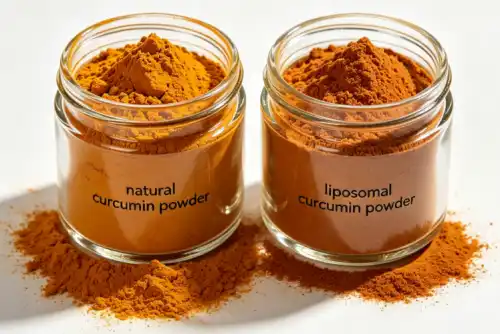
Curcumin is a natural polyphenol compound from Curcuma plants. There are two kinds of curcumin: traditional natural curcumin powder and liposomal curcumin powder. Many studies have confirmed its anti-inflammatory, antioxidant, and antitumor effects. However, the use of curcumin in medicine and functional foods is limited because of its poor physicochemical properties. Curcumin has very low water solubility, an unstable chemical structure, and rapid metabolism after oral absorption.
To solve these problems, researchers developed different drug delivery systems. Among them, liposome encapsulation technology is one of the most mature and widely used solutions. So what is the difference between curcumin and liposomal curcumin?
What Is the Difference Between Curcumin and Liposomal Curcumin?
Basic Physicochemical Properties and Structural Differences
• Molecular State and Crystal Structure
Traditional curcumin usually exists as a crystalline powder. In this form, curcumin molecules are tightly packed together and form a hydrophobic crystal structure. Because of this structure, curcumin is difficult to dissolve in water. Its Log P value is about 3.28, which shows strong hydrophobicity. Its water solubility is very low, about 11 ng/mL.
Liposomal curcumin powder does not change the molecular structure of curcumin. It changes the physical form of bulk curcumin. In this system, curcumin molecules are encapsulated inside phospholipid bilayer vesicles. Curcumin bulk powder exists in an amorphous or molecularly dispersed form. This changes curcumin from hydrophobic crystals into amphiphilic colloidal particles.
• Particle Size Difference
Traditional curcumin usually has particle sizes in the micrometer range. The particle distribution is often uneven.
Liposomal curcumin powder usually has particle sizes between 50 nm and 500 nm. The nano-sized particles are the main reason for the improved properties of liposomal curcumin.
Smaller particles provide a larger surface area. This increases the contact area between curcumin and biological membranes or solvents. Studies have shown that curcumin nanolipocarriers made by melt-emulsification can reach an average particle size of about 187.5 nm. This supports efficient oral absorption and possible intravenous injection applications.
Differences in Formulation Process and Physical Stability
From an industrial production view, the manufacturing processes are very different.
• Traditional Curcumin
Traditional curcumin bulk powder production mainly uses solvent extraction and recrystallization. The production process is relatively simple. Quality control mainly focuses on curcumin content, heavy metals, and microbial limits.
• Liposomal Curcumin
Liposomal curcumin powder production uses advanced technologies such as thin-film dispersion, reverse evaporation, and melt-emulsification.
The process requires dissolving phospholipids and curcumin in a specific ratio. Then particle size is controlled through high-pressure homogenization or ultrasonic treatment. Free curcumin is removed to measure encapsulation efficiency.
Encapsulation efficiency is an important indicator of liposome quality. High encapsulation efficiency helps liposomes deliver curcumin more effectively to the target site.
Traditional curcumin is sensitive to light, heat, and alkaline conditions. It can easily degrade during storage.
The phospholipid bilayer in liposomes acts as a protective barrier. Liposomal curcumin powder helps protect curcumin from environmental damage. Studies show that liposome encapsulation can improve the storage stability of curcumin.
However, liposomes are thermodynamically unstable systems. Problems such as phospholipid oxidation, particle aggregation, and drug leakage may occur during storage.
Guanjie Biotech improved the long-term stability of liquid liposomeal curcumin by optimizing phospholipid composition and surface modification technology.
What Is The Solubility and Dispersibility of Curcumin?
For customers, the processing performance of raw materials is very important.
•Curcumin
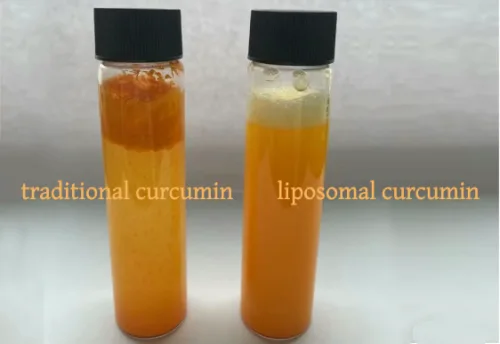
Natural curcumin powder is almost insoluble in water. It is only soluble in organic solvents such as ethanol and dimethyl sulfoxide. During the production of functional beverages or liquid products, curcumin easily precipitates. This limits its use in clear liquid formulations.
•Liposomal Curcumin
Liposomal curcumin powder has a phospholipid membrane with amphiphilic properties. Because of this, it can disperse evenly in water. It can form a transparent colloidal solution or emulsion. This makes it suitable for products that require high transparency. Such as, oral liquids, drops, and sprays. It also expands its application range.
Safety and Functional Comparison Based on Animal Studies
Safety
Studies show that free curcumin is a natural ingredient, but high-dose intravenous injection may cause hemolysis or vascular irritation. This may be related to solubilizers or curcumin deposition on blood vessel walls. After liposome encapsulation, hemolysis is greatly reduced. The safety of intravenous injection is improved. Studies also show that blank liposomal curcumin powder carriers have good biocompatibility and low cytotoxicity.
Functional Differences
Liposomal delivery systems show several important advantages.
•Anti-inflammatory and Liver Protection
In a carbon tetrachloride-induced liver injury model, liposomal curcumin showed better liver protection effects. It reduced oxidative stress, maintained reactive oxygen species (ROS) balance, and reduced mitochondrial damage.
• Targeted Delivery
Liposomal curcumin powder can achieve targeted delivery through surface modifications such as folic acid or antibodies.
For example, modified liposomes can deliver curcumin to ischemic myocardium or glioma tissues more effectively.
How To Choose, Traditional Curcumin or Liposomal Curcumin?
The choice of raw material depends on the application scenario, product form, cost budget, and expected effect.
Traditional Curcumin
• Applicable scenarios:
Solid tablets, hard capsules, oil-based suspensions such as soft capsules, emulsified sausages, and other food products.
• Advantages:
Lower cost. Wide regulatory acceptance. Suitable for large-scale production.
• Limitations:
Not suitable for transparent water-based beverages. It is also less competitive in high-end medical foods that require rapid effects and high absorption.
Liposomal Curcumin
Applicable scenarios:
High-end liquid beverages, including water-soluble clear drinks and microemulsion systems, oral solutions, pharmaceutical-grade formulations for adjuvant chemotherapy or inflammatory bowel disease (IBD), and topical high-permeability gels.
Advantages:
• Intravenous administration:
Free curcumin has poor safety for intravenous injection. It may cause hemolysis or phlebitis. Liposome encapsulation can improve injection safety and make parenteral administration possible.
• Targeting ability:
Surface modification, such as folic acid-chitosan coating, can improve cellular uptake and targeting ability.
• Synergistic therapy:
Liposomal curcumin powder can co-load other ingredients, such as resveratrol or the photothermal agent IR1061. This helps achieve combination therapy and synergistic effects.
Limitations:
Higher cost. Higher sterility requirements during production. Some liposomal curcumin powder formulations may become unstable in high alcohol concentrations or extreme pH conditions.
|
Characteristics |
Standard curcumin |
Liposome curcumin |
|
Core Issues |
Extremely low water solubility and oral bioavailability |
Utilizes a phospholipid bilayer to bypass solubility limitations |
|
Absorption Mechanism |
Passive diffusion, limited by dissolution rate |
Internalization and fusion absorption, resisting metabolic enzymes |
|
Relative Bioavailability |
Baseline (low) |
Increased absorption by several to ten times (depending on formulation process) |
|
Physical Formulation |
Crystallic powder, insoluble in water |
Nano-sized vesicles, dispersible in water to form colloidal solutions |
|
Formulation Cost |
Low |
Medium/high concentration (involves phospholipid raw materials and specialized equipment) |
Conclusion
The difference between curcumin and liposomal curcumin reflects the difference between traditional raw materials and modern nanotechnology. Traditional curcumin has very low solubility and a fast metabolic rate. Without special treatment, it is difficult for curcumin to provide strong systemic effects.
Liposomal curcumin powder uses phospholipid bilayer encapsulation technology. This technology improves the physical form, absorption pathway, and in vivo performance of curcumin. It also greatly improves bioavailability and targeting ability.
For customers looking for liposomal curcumin powder product upgrades and stronger market competitiveness, liposome technology is an effective solution to improve product value.Guanjie Biotech uses its supply chain advantages in plant extracts to provide a full range of products, from standard curcumin to customized liposomal curcumin. Our liposomal curcumin powder products are produced under GMP-compliant processes. We serve pharmaceutical, healthcare, and cosmetic companies in more than 100 countries. We help clients upgrade our products from raw materials to high-performance formulations. Welcome to enquire with us at info@gybiotech.com.
References
[1] Anand P, Kunnumakkara AB, Newman RA, Aggarwal BB. Bioavailability of curcumin: Problems and promises. Molecular Pharmaceutics. 2007;4(6):807-818.
[2] Ghanbarikondori P, Mir Hashemian P, Jalali F, Afyouni I, Sedighi A, Sadeghi Pour N. Studying the characteristics of curcumin-loaded liposomal nanoparticles. Asian Pacific Journal of Cancer Biology. 2024.
[3] Gujral I, et al. Comparative in vitro cytotoxicity of free curcumin and a liposomal curcumin formulation on various human cancer cell lines. Scientific Reports. 2026;16:6346.
[4] Isacchi B, Bergonzi MC, Iacona R, et al. Curcuminoids-loaded liposomes: influence of lipid composition on their physicochemical properties and efficacy as delivery systems. Colloids and Surfaces B: Biointerfaces. 2020.
[5] Yadav C, Asif M, Akhtar J, et al. An outline on curcumin: Its pro-liposome and liposome formulations. Research Journal of Pharmacy and Technology. 2020;13(12).
[6] Anand P, Kunnumakkara AB, Newman RA, Aggarwal BB. Bioavailability of curcumin: problems and prospects. Molecular Pharmaceutics. 2007;4(6):807-818.
[7] Ghanbarikondori P, Mir Hashemian P, Jalali F, Afyouni I, Sedighi A, Sadeghi Pour N. Characterization of curcumin liposome nanoparticles. Asia-Pacific Journal of Cancer Biology. 2024.
[8] Gujral I, et al. Comparative study on in vitro cytotoxicity of free curcumin and liposome curcumin preparations against different human cancer cell lines. Scientific Reports. 2026;16:6346.
[9] Isacchi B, Bergonzi MC, Iacona R, et al. Curcumin-loaded liposomes: the effect of lipid composition on their physicochemical properties and delivery system efficacy. Colloids & Surfaces: Biointerfaces. 2020.