Papain enzyme powder and bromelain enzyme powder are widely used in the food industry, especially in meat tenderisation. They effectively break down proteins in meat and improve the taste and tenderness of meat. There are significant differences between papain and bromelain in their meat tenderizing action. However, they are both natural proteolytic enzymes used in the food industry. The following is a detailed analysis of the differences between the two in meat tenderisation, their mechanisms, their application effects and their respective advantages and disadvantages.
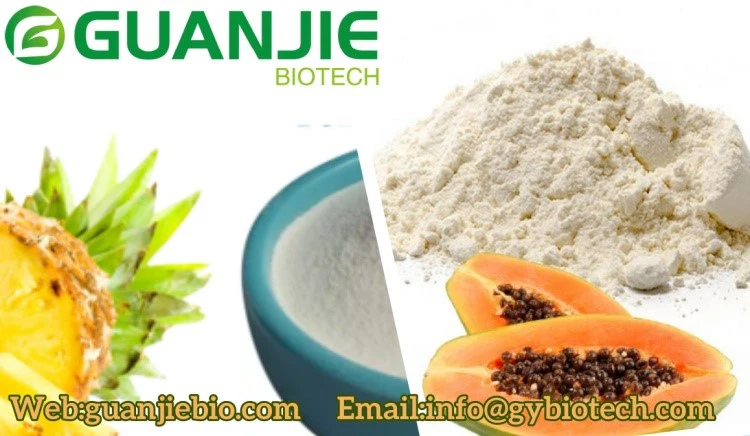
Differences In Enzyme Origin And Structure
• Papain:
Papain is a thiol protease (or mercapto protease) derived from the latex of unripe papaya and belongs to the trypsin family. Papain contains a reactive sulfur group in its structure, giving it a strong proteolytic capacity. It functions under both weakly acidic and alkaline conditions and is suitable for meat tenderisation over a wide pH range (4.0-8.0).
• Bromelain:
On the other hand, bromelain enzyme powder is a hybrid protein hydrolase extracted from bromelain stems and is a cysteine protease. The structure contains several active sites. It is mainly suitable for neutral to weakly acidic environments (pH 5.5-7.0). Its main components include bromelain A, bromelain B, and others. It is usually more susceptible to environmental conditions in its natural state.
Differences In The Mechanism Of Enzyme Action
• Mechanism of Papain:
Papain cleaves the complex actin and myosin cross-linking structures in meat through its sulfhydryl active sites during meat tenderisation. In particular, it hydrolyses some of the peptide bonds on cystine and lysine, resulting in shorter muscle fibres, looser structure and softer meat. In some of the more tolerant meats, papain enzyme powder has a strong catabolic effect and can significantly improve the tenderness of the meat. Such as beef.
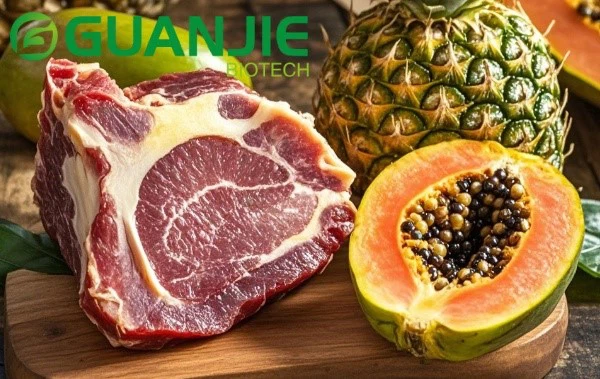
• Mechanism of Bromelain:
Bromelain is more inclined to act on collagen and elastin during meat tenderisation and its hydrolysis is gentler. This enzyme is particularly suitable for more tender meats such as seafood and chicken. This is because it can selectively break down muscle fibres without damaging the texture of the meat, resulting in a tender taste. However, due to its milder nature, it may not be as effective as papain on tougher meats.
Effect of enzyme on meat tenderising
• Papain:
Papain has a strong adaptability to the temperature of its action. It can work well in the range of 40-65℃. Therefore, it is very convenient to use it in a kitchen environment or at low temperatures. In addition, papain can tenderise under both acidic and alkaline conditions, which makes it more suitable for use in a wide range of meat processing and handling applications. Typically, papain has a fast tenderising action and changes in meat texture can be seen in a short time.
• Bromelain:
In contrast, bromelain enzyme powder has a slightly lower temperature range of action and is suitable for use between 30 and 60°C. It is also suitable for use in a variety of meat processing and treatment processes. It is therefore more demanding in terms of temperature conditions. At the same time, bromelain works best in a neutral to weakly acidic environment. Therefore, when bromelain is used to tenderise meat in cooking, the effect is usually enhanced by adding acid or controlling the temperature. In addition, the tenderising effect of bromelain is mild and suitable for less time-sensitive tenderising of meat.
Applications
• Application of papain in meat tenderisation:
Papain is widely used in the meat processing industry for tenderising red meat. For example, beef, lamb, etc. Especially used for steak tenderisation in Western cuisine. Papain makes these tougher meats more tender through a deep fibre breakdown effect. However, due to the high activity of papain enzyme powder, it may lead to loosening or excessive breakdown of the meat. Therefore, the amount of enzyme and the duration of action should be strictly controlled during use.
• Application of bromelain in meat tenderisation:
Bromelain's mildness makes it more effective in the treatment of more tender meat. For example, chicken and fish. These meats have shorter fibres and lower collagen content. Bromelain's gentle degradation improves the flavour without loosening the meat. In addition, bromelain powder bulk contains a small amount of bromelain flavour. It can add flavour to some light meats such as fish and shrimp, making the taste richer.
Effects on different meats
• Effect on Beef
Beef is rich in collagen and muscle proteins, and is one of the tougher meats in terms of fibre structure. By hydrolysing collagen and actin, papain can improve the tenderness of beef and make it easier to chew. In contrast, bromelain enzyme powder is slightly less effective on beef. This is because bromelain mainly degrades collagen. While it can make beef more tender, it is less effective on other structural proteins.
• Effectiveness on Pork
The protein composition in pork is more complex, including abundant collagen and muscle proteins. Papain showed a significant tenderising effect on pork, effectively breaking down the collagen in pork and improving the tenderness of pork by acting on muscle proteins. Bromelain bulk powder is also effective in pork tenderisation but usually requires a longer duration of action to see results.
• Effectiveness on Chicken
Chicken has a softer protein structure than beef and pork, making tenderisation easier to achieve. Papain and Bromelain are both very effective in tenderising chicken. Papain can effectively soften the meat and improve the taste when hydrolysing the proteins in chicken. Bromelain, on the other hand, is able to make chicken meat more tender and taste better by degrading collagen.
Practical Differences
• Source and Cost
Papain is mainly extracted from papaya. The cost is relatively low and the production is abundant. Bromelain, on the other hand, is mainly extracted from bromelain fruits and stems. Although bromelain is widely grown, the extraction process is relatively complex. Therefore, the production cost of bromelain is higher. Nonetheless, due to the different meat tenderising effects of the two, consumers tend to price their choices according to their specific needs.
• Concentration and treatment time
Papain enzyme powder can be used at lower concentrations and in shorter processing times to achieve rapid meat tenderisation. On the other hand, bromelain enzyme powder usually requires a higher concentration and a longer duration of action. Especially on thicker meats, more time is needed to complete the tenderisation.
• Temperature sensitivity
Papain is less sensitive to temperature. It maintains strong enzyme activity at higher temperatures. Therefore, it can be used during the cooking process. Bromelain is easily inactivated at higher temperatures. Therefore, it is usually used in low-temperature processing or in combination with other low-temperature processing methods.
• Possible negative effects
Excessive use of papain and bromelain may result in over-tenderisation of meat or even produce an overly mushy texture. In food processing, the use of these enzymes should be controlled in terms of dosage and duration of action to avoid affecting the texture of the meat.
Application And Market
Both papain and bromelain enzyme powder are widely demanded in food processing. Papain is more suitable for red meat processing due to its strong decomposition effect, while bromelain is widely used for tenderising light meats such as seafood and poultry. Papain and bromelain can often be used in combination depending on the meat and processing needs. They each have different mechanisms of action and advantages, and their combined use can be complementary in terms of meat tenderising effect. For example, in some processes, papain may be used to quickly tenderise the meat, and then bromelain may be used for further tenderisation to achieve the desired taste.
Papain and Bromelain have characteristics in meat tenderisation and are suitable for different meat tenderisation needs. Papain is suitable for tougher red meat with its strong breaking-down ability, while Bromelain is suitable for lighter meats such as poultry and seafood due to its mild tenderising effect. Choosing the right protease for tenderisation can achieve the desired taste and tenderness of meat, offering a wide range of applications in food processing and cooking. Guanjie Biotech has focused on papain enzyme powder and bromelain enzyme powder. If you want to use our products, welcome to enquiry us: info@gybiotech.com.