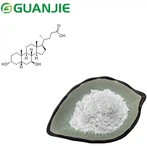
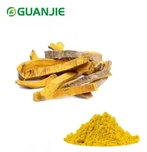
Berberine hydrochloride is a natural alkaloid widely found in various plants, especially in plants such as Coptis chinensis and Phellodendron amurense. Guanjie Biotech's berberine HCL bulk powder products are extracted from Coptis chinensis. It has high value in clinical and healthcare applications due to its good pharmacological activity. However, the low absorption rate of berberine hydrochloride has become a major limiting factor in its clinical application. In the following, the physicochemical properties and solubility of berberine hydrochloride will be discussed in detail, as to why it has a low absorption rate, and the reasons for this will be analyzed.

What Is Berberine hydrochloride?
Berberine hydrochloride is an isoquinoline alkaloid. It is found mainly in plants of the Berberidaceae family such as Berberis, Phellodendron Bark, and Panax ginseng. Its chemical formula is C20H18ClNO4 and its molecular weight is 371.81. Its chemical structure is a tetracyclic planar molecule with quaternary ammonium nitrogen atoms. The structure has rigidity and presents typical yellow crystals.
1. Physical properties
• Appearance: light yellow or bright yellow crystalline powder.
• Melting point: 145-149°C.
• Taste: Berberine HCL bulk powder tastes bitter, with alkaloidal properties.
• Optical properties: strong ultraviolet absorption, with absorption peaks at 265 nm and 345 nm.
2. Chemical properties
Berberine hydrochloride is a weakly alkaline compound. The quaternary ammonium nitrogen in the molecule enables it to combine with acid to form hydrochloride. This salt form is stable and easily soluble in water, which has good application value.
Solubility of berberine hydrochloride
The solubility of berberine hydrochloride directly affects. The solubility of berberine hydrochloride in water is low. However, the solubility in an acidic solution is relatively high. Solubility is better in alcohol solvents (e.g. ethanol, methanol). Lower solubility in fat-soluble solvents (e.g. fatty acids, vegetable oils, etc.).
• Water solubility
The solubility of berberine hydrochloride powder in water is relatively low. Usually, its solubility increases in a strongly acidic environment at pH 1-2. In neutral or alkaline solutions, its absorption in the gastrointestinal tract is less efficient.
• Solubility in organic solvents
Berberine hydrochloride has high solubility in alcoholic solvents. Especially in solvents such as methanol and ethanol. For fat-soluble solvents, such as oils and fats, fatty acids, etc., berberine hydrochloride has poor solubility.
• Solubility in the gastrointestinal tract:
The environment of the gastrointestinal tract is usually weakly acidic to neutral. Therefore, berberine hydrochloride has limited solubility in this environment. Due to the low solubility of Berberine HCL bulk powder, its availability in the gastrointestinal tract is greatly reduced, which also reduces its bioavailability.
Why Is Berberine HCL Absorption Low?
Despite the significant pharmacological effects of berberine hydrochloride, its oral bioavailability is low, leading to its poor absorption. The major factors affecting its absorption are listed below.
• Influence of molecular structure
The molecular structure of berberine hydrochloride contains several hydrophilic and hydrophobic groups. It exhibits low solubility. The aromatic and acidic rings and unsaturated hydrocarbon groups in the molecule make berberine hydrochloride relatively less hydrophilic. Although its hydrochloride form (berberine hydrochloride) is relatively soluble in water, it remains limited due to solubility. Its absorption in the gastrointestinal tract is limited.
• Barrier effect in the gastrointestinal tract
Berberine hydrochloride has a large molecular weight and complex molecular structure. Its difficult to pass through the cell membrane of intestinal epithelial cells. Although it has some absorption capacity in the intestinal tract. However, due to the large molecule, it cannot penetrate the intestinal cell membrane as quickly as some small molecule drugs. The lipid bilayer of intestinal epithelial cells acts as a significant barrier to large-molecule drugs.
• Micellisation and binding to bile acids
Berberine hydrochloride has certain lipophilic properties. Therefore, it may form micelles with bile acids in the intestines, and this can interfere with its absorption. Micellization with bile acids can aid the absorption of certain fat-soluble substances. However, for alkaloids with hydrophilic properties like berberine hydrochloride, its absorption is still limited and it may not be fully released into the aqueous phase. Therefore, it affects its absorption rate.
• First-pass effect
When Berberine HCL bulk powder is taken orally, it will first enter the liver. In the liver, it may be metabolized to other compounds, resulting in a lower concentration of the original drug in the body. This process is known as the 'first-pass effect'. It is a major cause of the low bioavailability of many orally administered drugs. Metabolism of berberine hydrochloride in the liver. This includes metabolism by the CYP450 enzyme system, which significantly reduces the amount of berberine that enters the circulation and thus affects its bioavailability.

• Binding of the drug to a colloidal solution
Berberine hydrochloride binds strongly to proteins, fats, and other molecules in the plasma. This binding reduces its free drug concentration and hence its effective concentration in the body. Most of the drugs bind to plasma proteins and form reversible conjugates, a process that also reduces the absorption of the drug.
• Effect of pH
Absorption of berberine hydrochloride powder in the gastrointestinal tract is also affected by pH. Its solubility is closely related to pH. And a low acidic environment in the stomach may not be favorable for its further dissolution and absorption. An acidic environment in the stomach has a positive effect on the solubility of many drugs. However, for berberine hydrochloride, a less acidic environment may limit its solubility.
• Drug Interactions
In the body, berberine hydrochloride may interact with other drugs to affect its absorption. Some drugs may alter the intestinal microbiota or enzyme activity in the gut, which may interfere with the absorption of berberine. In addition, berberine hydrochloride bulk powder may also interact with certain medications (e.g., antibiotics, antifungal medications, etc.), affecting their metabolism and absorption.
How to improve Berberine HCL Absorption?
To overcome the problem of low absorption of berberine HCL bulk powder, several measures have been taken by the scientific community and the pharmaceutical industry to improve its bioavailability.
• Use of improved dosage forms:
Nanotechnology, liposome technology, and microencapsulation have been used to improve the solubility and absorption of berberine hydrochloride. These technologies enable berberine hydrochloride to be made into smaller particles and increase its surface area, thereby increasing solubility and improving absorption.
• Combined use of other ingredients:
Studies have shown that certain co-ingredients can enhance the absorption of berberine hydrochloride. These ingredients improve the absorption of berberine hydrochloride by inhibiting elimination mechanisms in the gut or enhancing intestinal permeability.
• In conjunction with fatty food intake:
Certain studies have noted that consuming berberine hydrochloride in conjunction with high-fat foods enhances its absorption. This is because fatty foods increase the solubility of berberine hydrochloride in the intestines, which in turn increases its absorption.
Berberine hydrochloride has good pharmacological effects, but its low absorption rate is an important factor restricting its clinical application. Understanding its physicochemical properties, solubility, and the reasons for its low absorption rate, it can provide researchers with ideas to improve its bioavailability, such as nanotechnology, liposomal delivery systems, and other methods. Guanjie Biotech chose Phellodendron Bark as the Berberine hydrochloride bilk powder's raw material and used HPLC and titration assay to ensure the high quality and purity of Berberine Hydrochloride powder. If you want to buy berberine HCL in bulk, welcome to contact us at info@gybiotech.com.