Currently, commercial bulk liposomal raw materials come in two main forms: liposomal liquid and liposomal powder. Both share the same basic delivery mechanism. However, they differ in manufacturing processes, stability, storage and transport requirements, industrial scalability, application scenarios, and overall cost. Manufacturers should choose the appropriate form based on their production setup, product positioning, supply chain conditions, and target market needs. AndWhat Are The Differences Between Liposomal liquid And Liposomal Powder?
What Are the Differences Between Liposomal Liquid and Liposomal Powder?
Core Manufacturing Processes and Structural Characteristics
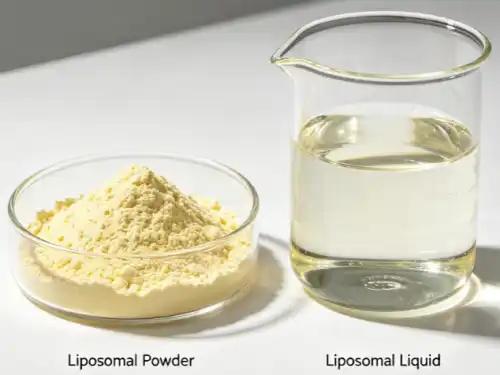
Liposomal liquid is the primary, native form of liposomes. It is produced using standard methods such as thin-film dispersion, high-pressure homogenization, and reverse-phase evaporation. During production, membrane materials (such as phospholipids and cholesterol) and active ingredients are emulsified, encapsulated, and homogenized in an aqueous system. This results in a uniform liquid suspension that does not require further drying. This form preserves the structural integrity and even dispersion of liposomal vesicles and maintains stable initial encapsulation efficiency. Because it avoids high or low drying temperatures, it is suitable for heat- or pressure-sensitive active ingredients. However, due to its high water content and dynamic suspension state, long-term storage may lead to physical changes such as vesicle fusion, sedimentation, and phase separation.
Liposomal powder is a solid form produced by further processing liposomal liquid. The main industrial methods are spray drying and freeze-drying, both of which are well-established for large-scale production. In this process, qualified liposomal liquid is used as the base material. Moisture is removed under controlled temperature and pressure conditions. Protective carriers are added to help maintain vesicle structure. The final product is a free-flowing powder with very low moisture content. Compared to laboratory-scale freeze-drying, industrial production allows continuous processing and reduces issues such as active ingredient leakage and vesicle rupture during drying. After rehydration, liposomal powder can quickly reform intact vesicle structures. Its encapsulation efficiency and bioavailability are similar to the original liposomal liquid. At the same time, it offers better stability for long-term storage and industrial handling.
Comparison of Storage Stability and Shelf Life
Stability is a key factor in raw material selection. It directly affects inventory turnover, product yield, and finished product shelf life.
• Liquid liposomes
Liquid liposomes have inherent stability limitations. They contain an aqueous phase. This makes them prone to phospholipid oxidation and hydrolysis. Active ingredients may degrade over time. Under standard conditions, liquid liposomes require cold-chain storage. They must be protected from light and kept at 2–8°C. Their typical shelf life is 12–24 months.
At room temperature, liquid liposomes often become unstable. Phase separation may occur. Turbidity may appear. Active ingredients may lose potency. Long-term storage is not suitable. These strict storage requirements increase equipment needs and management costs.
• Liposomal powder
Liposomal powder solves these problems. They are dry solid systems. They greatly reduce oxidation, hydrolysis, and microbial growth. Active ingredients remain more stable.
Liposomal powders can be stored at room temperature in dry conditions. No cold chain is needed. Their standard shelf life can reach up to 36 months. Some stable formulations last even longer.
Powder forms are also less sensitive to environmental changes. They can tolerate temperature ranges from -25°C to 40°C. This makes them suitable for global storage conditions. They reduce inventory risk and support long-term stockpiling.
Storage and Transport Costs and Supply Chain Compatibility
In bulk liposomal powder and liquid procurement and cross-border logistics, storage and transport costs are critical.
• Liquid liposomes
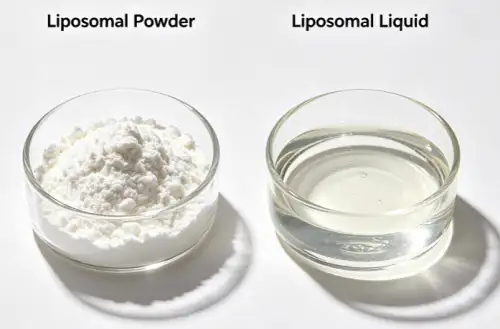
Liquid liposomes contain more than 70% water. They are heavy and bulky. This increases transportation cost per unit of active ingredient. They also require continuous cold-chain transport. This further increases logistics costs.
Cold-chain transport also carries risks. Temperature control failure can cause spoilage. Long-distance shipping increases loss rates. Liquid liposomes are therefore more suitable for short-distance and small-batch use.
• Liposomal powder
Liposomal powder has a higher active concentration. Their weight and volume are about one-fifth to one-eighth of liquid products with the same activity. This greatly reduces storage and shipping space. They do not require cold-chain logistics. They can be shipped by sea, land, or air. This improves supply chain flexibility. It also reduces the risk of transport failure. Overall logistics costs are significantly lower. Loss rates are also reduced. This makes powder forms more suitable for global bulk procurement and long-term storage.
For companies operating in global markets,Liposomal powder offers better supply chain compatibility. With a mature production system, Guanjie Biotech can support large-volume orders and stable long-term supply across multiple regions.
Suitability for Industrial Production
Production line compatibility directly affects processing efficiency and reformulation costs. Liposomal liquids are liquid systems. They are compatible only with a limited range of liquid products, such as oral solutions, beverages, and softgels. This limits their application scope.
• Liposomalliquid
For solid dosage forms, liquid liposomes cannot be used directly. They require extra concentration and drying steps. These steps may cause loss of active ingredients. They are also not suitable for mainstream solid production lines, such as tablets, powders, granules, solid beverages, and meal replacement powders. This leads to poor process compatibility. In addition, liquid raw materials are difficult to dose precisely. Large-scale production may show batch-to-batch color variation and inconsistent active content.
• Liposomal powder
In contrast, liposomal powders show strong industrial adaptability. They have good flowability, uniformity, and dispersibility. They meet the requirements of bulk industrial processing. They can be directly used in many solid products, including tablets, capsules, solid beverages, functional powders, and granules. They can also be re-dispersed for liquid applications, allowing flexible use. Powder forms allow accurate dosing and easy integration with automated production systems. This improves efficiency and reduces batch variation. They can also be blended directly with other powdered excipients. Their wide compatibility reduces formulation conflicts and lowers process modification and quality control costs.
Different Bioavailability
In terms of efficacy, both liposomal liquids and powders, when produced under compliant processes, show similar delivery performance. Both provide good stability, sustained release, and protection against degradation. They also improve bioavailability, with no major difference in functional outcome.
Different Application Scenarios
The main difference is application suitability. Liposomal liquids do not require reconstitution. They are simple to use and suitable for small-batch, high-end liquid products, such as premium oral solutions and customized supplements. They fit a "ready-to-fill" production model.
Liposomal powders offer broader industrial use. They support storage, transport, and processing advantages. They are suitable for large-scale production and standardized distribution. They are widely used in functional beverages, capsules, tablets, cosmetics powders, and other solid formulations. They also support cross-border supply chains. In addition, powder forms do not require preservatives. This supports clean-label product development and matches current health-focused market demand.
FAQs:
1.What are the main forms of commercial liposomal raw materials?
Commercial liposomal raw materials are mainly available in two forms: liposomal liquid and liposomal powder. Both use liposome encapsulation technology to deliver active ingredients effectively, but they differ in physical state and industrial performance.
2. What is liposomal liquid?
Liposomal liquid is the original form of liposomes. It is produced through processes such as thin-film dispersion, high-pressure homogenization, or reverse-phase evaporation. The final product is an aqueous suspension of phospholipid vesicles containing active ingredients.
3. What is liposomal powder?
Liposomal powder is a solid form created by further processing liposomal liquid using spray drying or freeze-drying. The process removes water and converts the system into a dry, free-flowing powder that can be rehydrated when needed.
4. How do the manufacturing processes differ?
Liposomal liquid is produced and used directly in a wet dispersion system. Liposomal powder requires an additional drying step where water is removed under controlled conditions, often with protective carriers added to maintain vesicle integrity.
5. How do they differ in stability and shelf life?
Liposomal liquid is less stable due to its water content and typically requires cold-chain storage (2–8°C) with a shelf life of around 12–24 months. Liposomal powder is more stable, can be stored at room temperature, and typically has a shelf life of up to 36 months or longer under dry conditions.
6. What are the differences in storage and transportation?
Liposomal liquid is heavy, bulky, and requires refrigerated transport, increasing logistics cost and risk. Liposomal powder is lightweight, compact, and does not require cold-chain logistics, making it more suitable for global shipping and long-term storage.
Summary
When considering the full range of requirements, including industrial production, cost control, supply chain logistics, and end-product applications, liposomal liquids are only suitable for niche production. They fit small batches, short lead times, and liquid end products. However, they have clear drawbacks, including poor stability, high cost, and limited versatility.
In contrast, liposomal powders are now the mainstream choice for bulk liposome raw material procurement. They offer key advantages, including long shelf life, room-temperature storage and transport, lower cost, broad manufacturing compatibility, and minimal product loss. They are better suited for large-scale, standardized, and global industrial production.
Guanjie Biotech specializes in bulk liposomal powder production. The company focuses on product innovation and standardized quality control. It has built a large-scale production system that consistently delivers liposomal powders with high encapsulation efficiency, strong stability, and reliable batch consistency.
With a global supply chain covering more than 100 countries and regions, Guanjie Biotech supplies stable bulk materials worldwide. It also provides customized formulation development and strict quality assurance. These capabilities help downstream companies reduce costs, improve efficiency, expand product lines, and strengthen market competitiveness. Welcome to enquire with us at info@gybiotech.com.
References:
[1]Jara-Quijada, E., et al. (2026). Evaluation of chitosan-coated liposome drying methods using freeze-drying, vacuum microwave drying, and spray drying: Physicochemical properties, energy efficiency, and CO2 emissions. Food Bioscience, 75, 108093.
[2]Kianfar, F., et al. (2025). Development of Spray-Dried Micelles, Liposomes, and Solid Lipid Nanoparticles for Enhanced Stability. Pharmaceutics, 17(1), 122.
[3]Trucillo, P., et al. (2025). Supercritical Particle formation (SPAF) process for the versatile production of ready-to-market drug delivery systems. Chemical Engineering Science, 302, 120918.
[4]Shin, D. H., et al. (2022). Development of a child-friendly oral drug formulation using liposomal multilamellar vesicle technology. Pharmaceutics, 14(10), 2049.
[5] Xie Yangui. (2009). Preparation and evaluation of myricitrin liposomes (Master's thesis, South China University of Technology). Wanfang Data Knowledge Service Platform.
[6] Jiasheng (Hong Kong) Technology Co., Ltd. (2023). Introduction to and application of high-pressure homogenization for liposome preparation (FBF, Italy). Bio-Online.